2 Chronicles 36 KJV
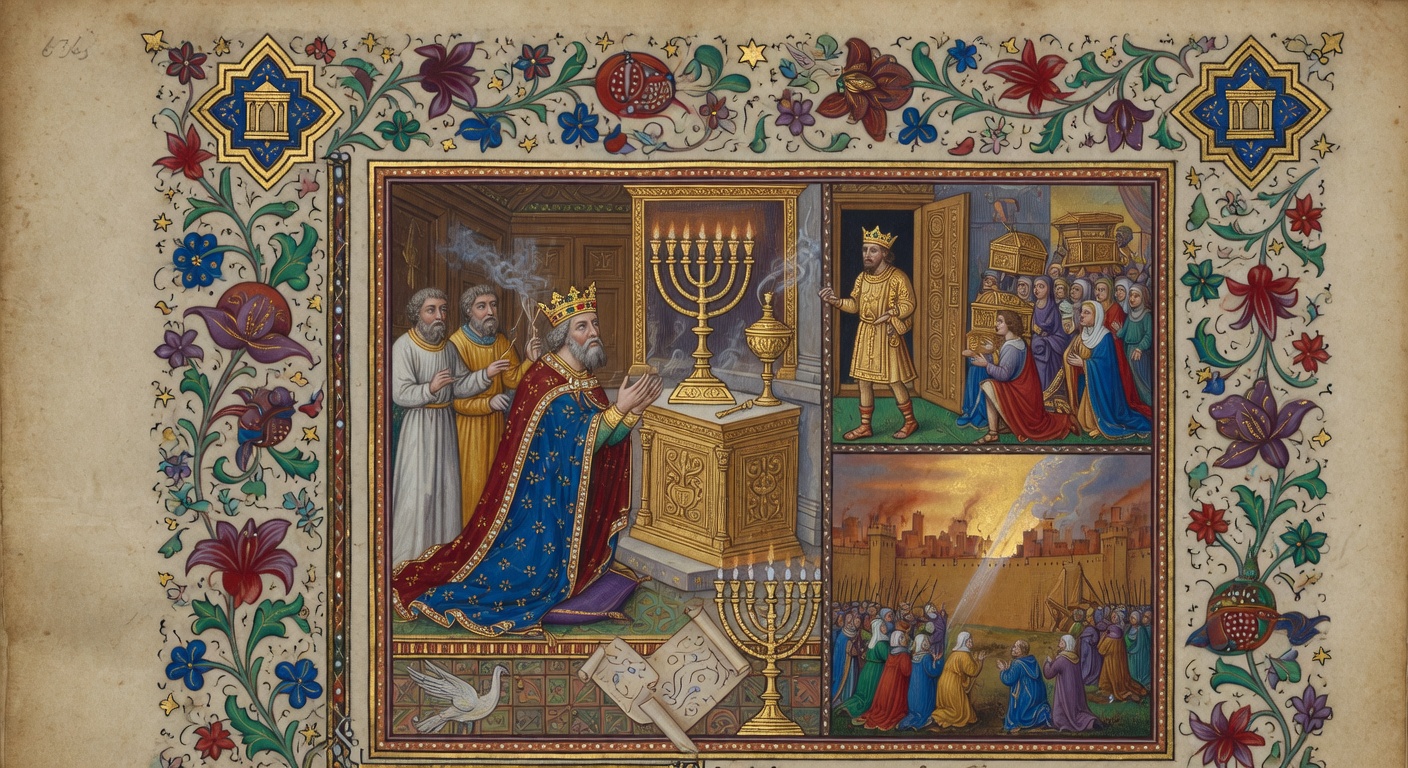
The Fall of Jerusalem
2 Chronicles Chapter 36: The Fall of Jerusalem
The chapter uniquely frames the seventy-year exile as the land finally enjoying its neglected sabbaths, directly enacting Leviticus 26:34-35 and supplying a sabbatical theology of judgment absent from the parallel in Kings.
 1hen the people of the land took Jehoahaz the son of Josiah, and made him king in his father’s stead in Jerusalem.
2 Jehoahaz was twenty and three years old when he began to reign, and he reigned three months in Jerusalem.
3 And the king of Egypt put him down at Jerusalem, and condemned the land in an hundred talents of silver and a talent of gold.
4 And the king of Egypt made Eliakim his brother king over Judah and Jerusalem, and turned his name to Jehoiakim. And Necho took Jehoahaz his brother, and carried him to Egypt.
5 Jehoiakim was twenty and five years old when he began to reign, and he reigned eleven years in Jerusalem: and he did that which was evil in the sight of the LORD his God.
6 Against him came up Nebuchadnezzar king of Babylon, and bound him in fetters, to carry him to Babylon.
7 Nebuchadnezzar also carried of the vessels of the house of the LORD to Babylon, and put them in his temple at Babylon.
8 Now the rest of the acts of Jehoiakim, and his abominations which he did, and that which was found in him, behold, they are written in the book of the kings of Israel and Judah: and Jehoiachin his son reigned in his stead.
9 Jehoiachin was eight years old when he began to reign, and he reigned three months and ten days in Jerusalem: and he did that which was evil in the sight of the LORD.
10 And when the year was expired, king Nebuchadnezzar sent, and brought him to Babylon, with the goodly vessels of the house of the LORD, and made Zedekiah his brother king over Judah and Jerusalem.
11 Zedekiah was one and twenty years old when he began to reign, and reigned eleven years in Jerusalem.
12 And he did that which was evil in the sight of the LORD his God, and humbled not himself before Jeremiah the prophet speaking from the mouth of the LORD.
13 And he also rebelled against king Nebuchadnezzar, who had made him swear by God: but he stiffened his neck, and hardened his heart from turning unto the LORD God of Israel.
14 Moreover all the chief of the priests, and the people, transgressed very much after all the abominations of the heathen; and polluted the house of the LORD which he had hallowed in Jerusalem.
15 And the LORD God of their fathers sent to them by his messengers, rising up betimes, and sending; because he had compassion on his people, and on his dwelling place:
16 But they mocked the messengers of God, and despised his words, and misused his prophets, until the wrath of the LORD arose against his people, till there was no remedy.
17 Therefore he brought upon them the king of the Chaldees, who slew their young men with the sword in the house of their sanctuary, and had no compassion upon young man or maiden, old man, or him that stooped for age: he gave them all into his hand.
18 And all the vessels of the house of God, great and small, and the treasures of the house of the LORD, and the treasures of the king, and of his princes; all these he brought to Babylon.
19 And they burnt the house of God, and brake down the wall of Jerusalem, and burnt all the palaces thereof with fire, and destroyed all the goodly vessels thereof.
20 And them that had escaped from the sword carried he away to Babylon; where they were servants to him and his sons until the reign of the kingdom of Persia:
21 To fulfil the word of the LORD by the mouth of Jeremiah, until the land had enjoyed her sabbaths: for as long as she lay desolate she kept sabbath, to fulfil threescore and ten years.
22 Now in the first year of Cyrus king of Persia, that the word of the LORD spoken by the mouth of Jeremiah might be accomplished, the LORD stirred up the spirit of Cyrus king of Persia, that he made a proclamation throughout all his kingdom, and put it also in writing, saying,
23 Thus saith Cyrus king of Persia, All the kingdoms of the earth hath the LORD God of heaven given me; and he hath charged me to build him an house in Jerusalem, which is in Judah. Who is there among you of all his people? The LORD his God be with him, and let him go up.
← → arrow keys to navigate chapters · spacebar to play/pause audio
Did You Know?
The chapter uniquely frames the seventy-year exile as the land finally enjoying its neglected sabbaths, directly enacting Leviticus 26:34-35 and supplying a sabbatical theology of judgment absent from the parallel in Kings.
Zedekiah’s rebellion is presented as the violation of an oath sworn by God to Nebuchadnezzar, underscoring the Chronicler’s preoccupation with covenant integrity and aligning with Ezekiel’s condemnation of broken oaths (Ezekiel 17).
The repeated declaration that the people ‘had no remedy’ after scorning the messengers signals the crossing of a threshold of irrevocable judgment, echoing the prophetic motif of a point of no return found in Isaiah 6 and Jeremiah 7.
By ending abruptly with Cyrus’s decree, the chapter transforms a narrative of total collapse into an implicit summons for the post-exilic community to rebuild the temple, making 2 Chronicles function as a bridge to Ezra rather than a mere historical coda.
The selective mention of temple vessels being carried to Babylon (rather than the blinding of Zedekiah) foreshadows their reappearance in Daniel 5, portraying the sacred objects as living witnesses to YHWH’s sovereignty over successive empires.
Commentary & Study Notes Jamieson-Fausset-Brown (1871) · Public Domain the people of the land took Jehoahaz — Immediately after Josiah's overthrow and death, the people raised to the throne Shallum (1Ch 3:15), afterwards called Jehoahaz, in preference…
Classic verse-by-verse commentary on 2 Chronicles 36 from Jamieson, Fausset & Brown (1871). Covers: Jehoahaz, succeeding, is deposed by Pharaoh; Jehoiakim, reigning ill, is carried into Babylon; Zedekiah's reign; Cyrus' proclamation.
- 1
- the people of the land took Jehoahaz — Immediately after Josiah's overthrow and death, the people raised to the throne Shallum (1Ch 3:15), afterwards called Jehoahaz, in preference to his older brother Eliakim, from whom they expected little good. Jehoahaz is said (2Ki 23:30) to have received at Jerusalem the royal anointing — a ceremony not usually deemed necessary, in circumstances of regular and undisputed succession. But, in the case of Jehoahaz, it seems to have been resorted to in order to impart greater validity to the act of popular election; and, it may be, to render it less likely to be disturbed by Necho, who, like all Egyptians, would associate the idea of sanctity with the regal anointing. He was the youngest son of Josiah, but the popular favorite, probably on account of his martial spirit (Eze 19:3) and determined opposition to the aggressive views of Egypt. At his accession the land was free from idolatry; but this prince, instead of following the footsteps of his excellent father, adopted the criminal policy of his apostatizing predecessors. Through his influence, directly or indirectly used, idolatry rapidly increased (see 2Ki 23:32).
- 2
- he reigned three months in Jerusalem — His possession of sovereign power was of but very brief duration; for Necho determined to follow up the advantage he had gained in Judah; and, deeming it expedient to have a king of his own nomination on the throne of that country, he deposed the popularly elected monarch and placed his brother Eliakim or Jehoiakim on the throne, whom he anticipated to be a mere obsequious vassal. The course of events seems to have been this: on receiving intelligence after the battle of the accession of Jehoahaz to the throne, and perhaps also in consequence of the complaint which Eliakim brought before him in regard to this matter, Necho set out with a part of his forces to Jerusalem, while the remainder of his troops pursued their way at leisure towards Riblah, laid a tribute on the country, raised Eliakim (Jehoiakim) as his vassal to the throne, and on his departure brought Jehoahaz captive with him to Riblah. The old expositors mostly assumed that Necho, after the battle of Megiddo, marched directly against Carchemish, and then on his return came to Jerusalem. The improbability, indeed the impossibility, of his doing so appears from this: Carchemish was from four hundred to five hundred miles from Megiddo, so that within "three months" an army could not possibly make its way thither, conquer the fenced city of Carchemish, and then march back a still greater distance to Jerusalem, and take that city [KEIL].
Read all 10 notes on 2 Chronicles 36 →